
When building a diversified stock portfolio, it's important to focus on proven risk premiums.
While many investors understand the difference between stocks and bonds, fewer realize there are additional dimensions of risk within the stock market itself that have historically been associated with higher expected returns. Understanding these risk premiums can help investors build more intentional and diversified portfolios.
What is a Risk Premium?
A risk premium is the additional expected return an investor receives for taking on additional risk.
The most familiar example is the market premium. Investors generally expect stocks to provide higher returns than bonds because stocks carry greater risk. That additional expected return can be thought of as compensation for accepting the uncertainty that comes with owning stocks.
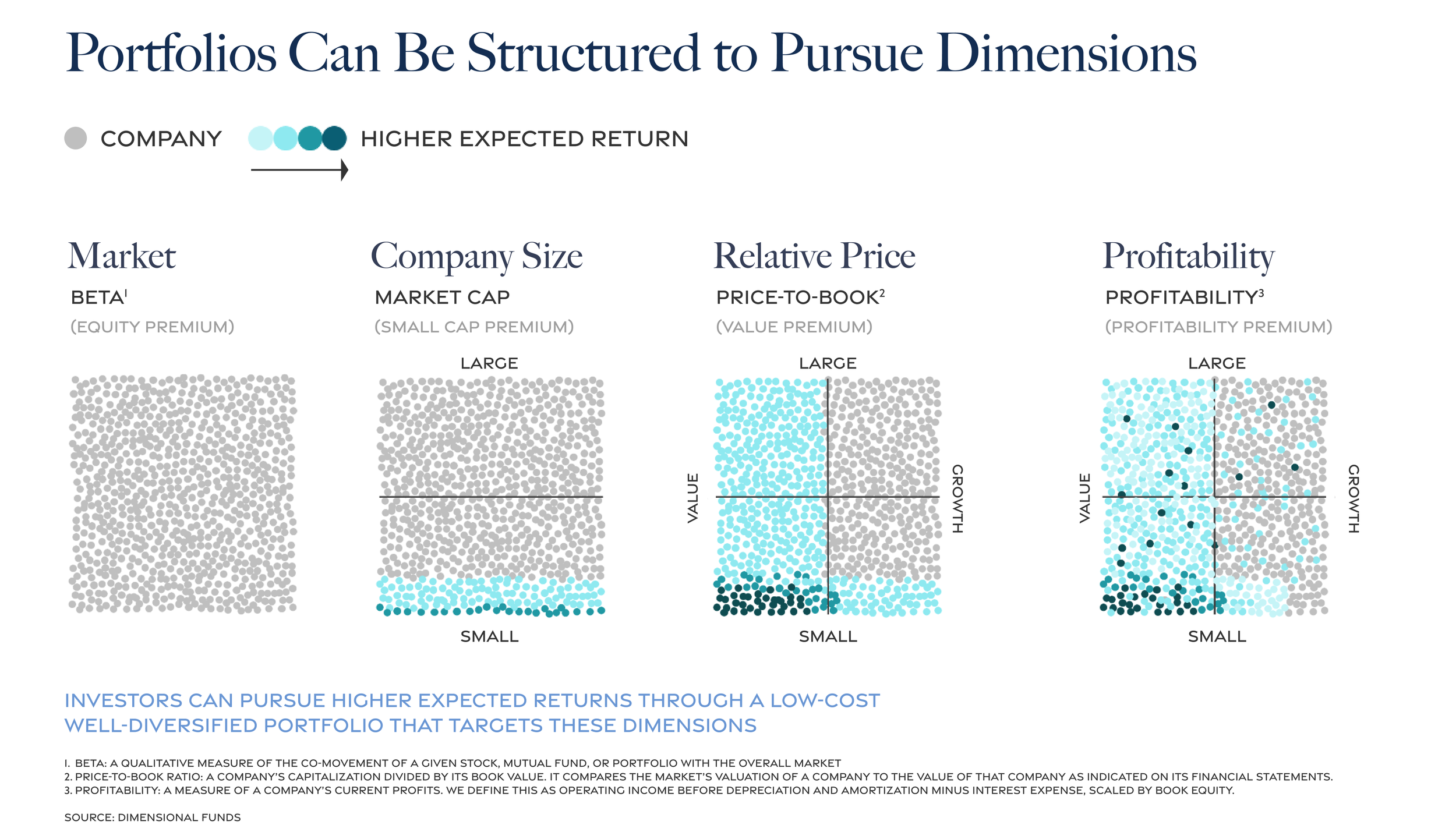
Beyond the market premium, there are three additional equity risk premiums that have historically appeared in stock markets around the world:
Company size
Relative price (often called value)
Profitability
Together, these four dimensions form the core equity risk premiums investors can consider when constructing a diversified equity portfolio.
The Four Dimensions of Equity Risk Premiums
1. Market Premium
The market premium reflects the difference between owning stocks and owning bonds. Bonds represent legal, fixed debt, while purchasing a stock essentially gives you a piece of company ownership, which is typically more volatile. Because stocks carry greater risk, investors generally expect higher long-term returns in exchange for accepting that potential greater downside.
2. Company Size
The size premium is based on the observation that smaller companies tend to be riskier than larger companies. Because investors take on additional risk when owning smaller companies, they should expect a higher return in exchange.
3. Relative Price (Value)
The relative price premium, often referred to as the value premium, compares value companies with growth companies.
Growth companies typically trade at higher price-to-book ratios because investors expect future growth. Value companies tend to trade at lower price-to-book ratios and may be viewed by the market as facing greater uncertainty or challenges.
Because of that additional risk, investors should expect a higher return for owning value companies compared to growth companies.
4. Profitability
The profitability premium focuses on the relationship between company profitability and returns.
Historically, companies with higher profitability have tended to deliver higher returns than companies with lower profitability. The data shows that profitability has been another important dimension of expected return within equity markets.
How Risk Premiums Are Distributed Across The Market
These risk premiums do not exist in isolation.
Investors can begin by seeking the market premium through stock ownership, then add exposure to other dimensions of expected return. For example, a small value company may provide exposure to both the size and value premiums, while profitability can be found across different segments of the market.
As a result, portfolios can be structured to pursue multiple dimensions of expected return rather than relying solely on broad market exposure.
What Have Risk Premiums Looked Like Historically?
The historical data referenced in the video above provides an example of how these premiums have appeared in the marketplace over time.
Small Companies vs. Large Companies
The long-term average return of the total U.S. stock market has been approximately 10%.
Large-cap stocks have historically produced returns close to that figure, with a long-term return of approximately 9.98%.
Small-cap stocks, however, have historically delivered returns of approximately 12.7%, demonstrating the size premium.
Value Companies vs. Growth Companies
Growth stocks have historically produced returns of approximately 9.5%.
Value stocks, on the other hand, have historically generated returns of approximately 12.66%.
This difference illustrates the value premium and the additional expected return investors have historically received for owning value-oriented companies.
Combining Size and Value
When size and value are combined, the historical effect becomes even more pronounced.
Small value stocks have historically produced returns of approximately 14.5%, reflecting the combined impact of both the size and value premiums.
Evidence Across Global Markets
One of the strongest pieces of evidence supporting these risk premiums is that they have not been limited to the United States.
Historically, similar patterns have appeared across U.S. markets, developed international markets, and emerging markets. Across these regions, small companies have generally outperformed large companies, while value companies have generally outperformed growth companies over long periods. Similar trends have also been observed for profitability.
The Role Time Plays in Risk Premiums
Risk premiums are not guaranteed to appear every year. In fact, they cannot be. If investors knew stocks would outperform bonds every year, there would be no risk and therefore no premium.
The same principle applies to size, value, and profitability. While historical evidence supports these premiums over long periods, there are many shorter periods when they underperform. The uncertainty surrounding when these premiums will appear is part of what creates the opportunity for higher expected returns over time.
For investors, this reinforces the importance of maintaining a long-term perspective and staying disciplined through different market environments.
Building a Portfolio Around Proven Risk Premiums
Risk premiums have been observed across different time periods, market environments, and regions around the world.
Rather than concentrating solely on large-cap growth companies, investors can structure portfolios to pursue multiple dimensions of expected return, including market exposure, company size, relative price, and profitability.
A thoughtfully diversified portfolio seeks to capture these proven risk premiums while maintaining a long-term perspective through the periods when they may not show up immediately.
If you'd like help building a diversified portfolio that incorporates these dimensions of expected return, request a meeting with the Navigoe team to discuss how a long-term investment strategy can support your financial goals.
With respect to concepts around Modern Portfolio Theory, keep in mind the following: Diversification does not ensure a profit or protect against loss, particularly in a broad-based market decline. Remaining fully invested exposes the portfolio to the full extent of market downside; avoiding market timing does not avoid market risk. Diversification and correlation assumptions are drawn from historical data and may not hold during future market conditions. Any mention of Dimensional Fund Advisors is not a recommendation. Comments around the history of Navigoe reflect an adherence to an investment philosophy and are not claims of past performance. Past performance is not an indication of future returns. Investing in securities involves the risk of loss.