
Active Management vs. Index Investing: Understanding the Trade-offs
When people think about investing, they may picture a scenario where they find the right manager who can pick the best stocks and consistently outperform the market.
This approach is known as active management, and for many years it shaped how investors thought about building portfolios. The premise is straightforward. A professional manager studies companies, analyzes financial data, and selects investments they think will perform better than the broader market.
In theory, this sounds appealing. If a manager truly has the skill to identify winning investments, investors could potentially earn higher returns than the overall market.
In reality, markets rarely work that way.
What is Active Management?
Active management is an investment strategy where a portfolio manager attempts to outperform the market by selecting specific stocks or bonds.
To understand the difficulty of this approach, consider how markets function. Every trade in the market has two sides. When someone buys a stock, another investor is selling it. The buyer believes the investment will perform better than the market average, while the seller believes it will perform worse.
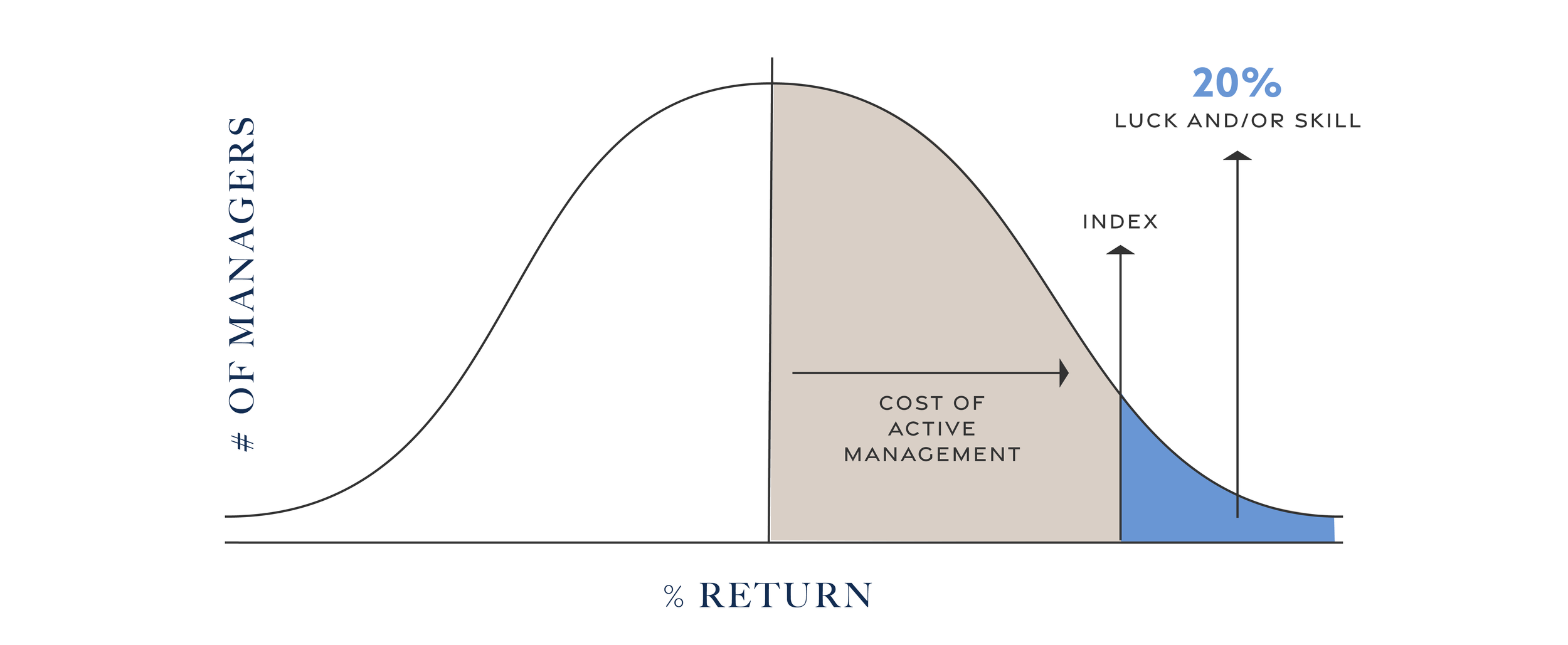
Because of this dynamic, both sides of the trade cannot be correct at the same time. Across thousands of investment decisions, the performance of professional managers tends to form a bell-shaped distribution. Some managers significantly outperform the market, some significantly underperform, and many land somewhere in the middle.
If you imagine plotting those results on a chart, an index that simply owns all of the underlying investments should theoretically sit near the average. In practice, however, the index often outperforms most actively managed funds.
Why Active Management Often Falls Behind
One of the primary reasons active managers struggle to outperform the index comes down to cost.
Active management includes several layers of expenses that investors must bear, including:
Management fees or expense ratios
Trading and transaction costs
Market frictions that occur whenever securities are bought or sold
These costs may seem small individually, but over time they can significantly reduce returns.
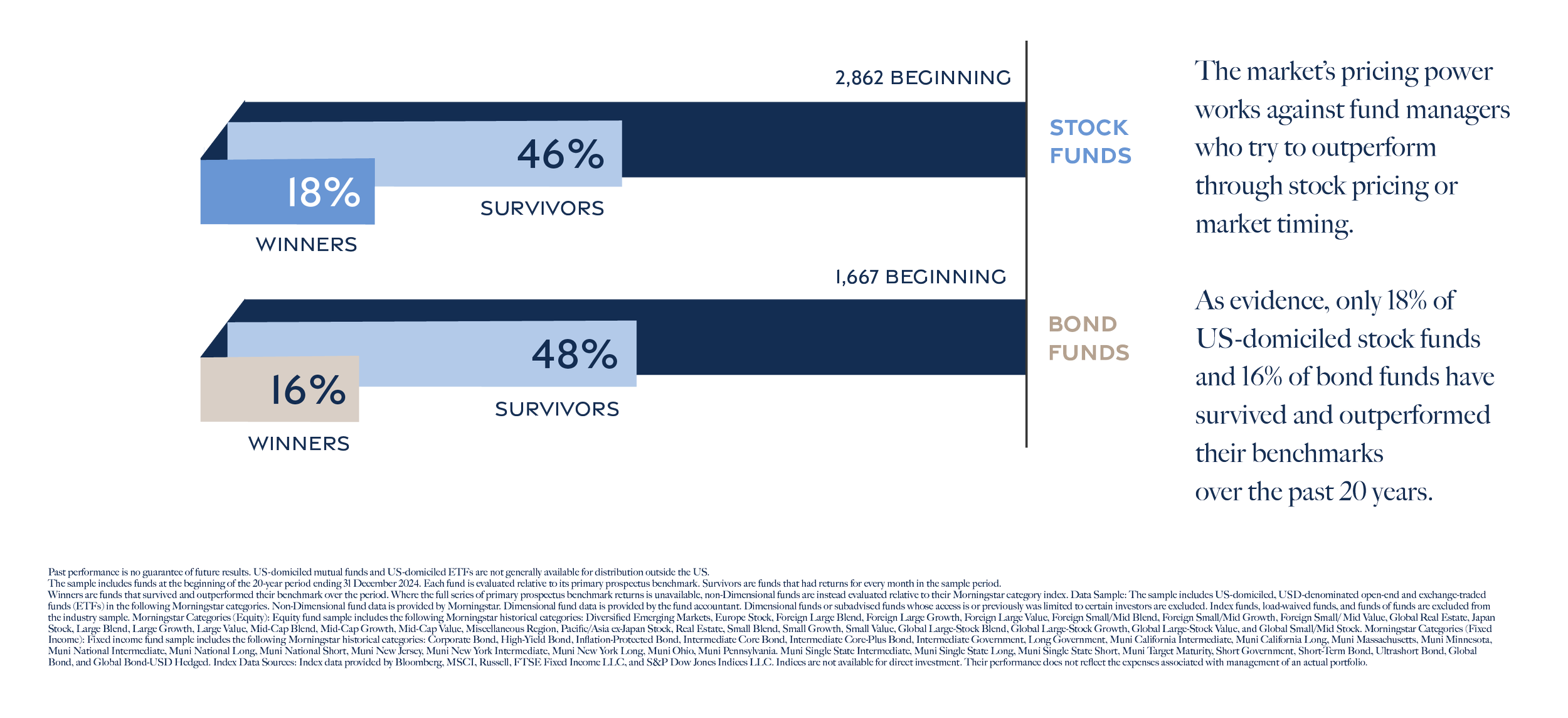
Research examining the period from 2005 through 2024 illustrates this clearly. Over that time, thousands of U.S. domiciled funds attempted to outperform their benchmarks. By the end of the period, only 46% of stock funds and 48% of bond funds were still in existence — a sign that the funds were not successful in delivering the desired returns.(1)
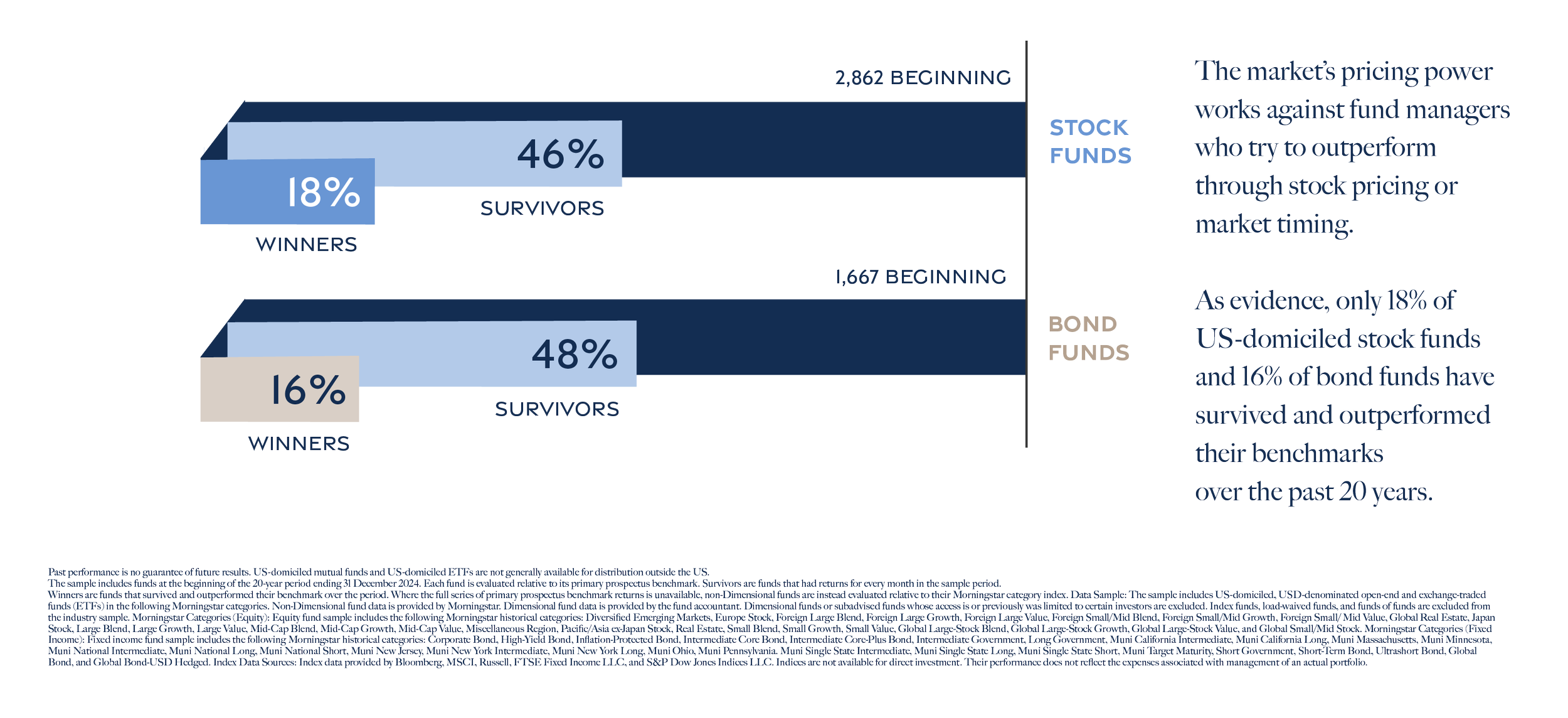
Among the funds that survived, the group that outperformed their benchmark over that same period was relatively small:
18% of stock funds outperformed their benchmark.
16% of bond funds did the same.(1)
In other words, based on this data, the majority of actively managed funds did not outperform their benchmark over that period.
Why Past Performance Rarely Repeats
Supporters of active management often argue that skilled managers do exist and strong performers can be identified over time.
One way to test this idea is to examine whether top-performing funds continue to outperform in the future. Looking at the top 25% of funds over a five-year period, only 23% of stock funds remained in the top group during the following five years. For bond funds, the figure was about 34%.(1)
In most cases, funds that ranked near the top during one period didn’t maintain that position during the next.
For investors, this naturally raises a question. If only a small percentage outperform and those results rarely repeat, is the difference driven by skill or by luck? The statistics point to the latter.
What Is Index Investing?
Given the difficulty of consistently outperforming the market, many investors turn to index investing, also known as a passive management strategy.
Instead of trying to identify individual winners, index investing focuses on owning the market itself. An index is a group of securities designed to represent a particular segment of the market, such as large U.S. companies or global stocks.
Index funds and passively managed exchange-traded funds (ETFs) track these indexes and allow investors to capture the overall market return.
This approach offers several advantages:
Lower investment costs
Built-in diversification
A disciplined, long-term investment framework
Rather than attempting to outperform the market, index investing focuses on participating in the returns the market provides.
A Common Misunderstanding About Index Investing
While index investing can be an effective strategy, it’s sometimes misunderstood.
Some investors assume purchasing a single index fund automatically provides sufficient diversification. For example, someone might buy an ETF that tracks the S&P 500 and assume they have broad exposure to the overall market.
However, relying on a single index fund can still leave gaps in a portfolio.
An investor may unknowingly have heavy exposure to:
One country or region
A small group of large companies
A specific industry or sector
For index investing to work well, it needs to be part of a thoughtfully diversified portfolio.
Building a Passive Strategy the Right Way
A disciplined investment strategy begins with the investor, not the market.
Important considerations include:
Your long-term financial objectives
Your tolerance for market volatility
Your time horizon for investing
Your need for income or long-term growth
These factors help guide how a portfolio should be structured. From there, a diversified portfolio of index-based investments can be built to align with those goals.
This approach allows investors to focus on the factors they can control, including costs, diversification, and long-term discipline.
A Disciplined Approach to Investing
The data suggests that consistently outperforming the market through stock picking and active management is extremely difficult. Passively owning the market through index funds allows investors to capture market returns while avoiding many of the costs associated with active management.
That said, even a passive investment strategy still requires thoughtful planning. Investors need to determine how much risk they’re comfortable taking, how their portfolio should be diversified across markets, and how their investments align with long-term financial goals.
A wealth management firm can help guide those decisions by designing a diversified investment strategy, monitoring portfolio allocation, and helping investors stay disciplined during periods of market uncertainty.
If you’d like to discuss how an investment strategy could support your long-term financial goals, we invite you to schedule a conversation with the Navigoe team.
Source:
1 (2025.) Pursuing a Better Investment Experience [PowerPoint slides]. Dimensional Fund Advisors. www.dimensional.com
With respect to concepts around Modern Portfolio Theory, keep in mind the following: Diversification does not ensure a profit or protect against loss, particularly in a broad-based market decline. Remaining fully invested exposes the portfolio to the full extent of market downside; avoiding market timing does not avoid market risk. Diversification and correlation assumptions are drawn from historical data and may not hold during future market conditions. Any mention of Dimensional Fund Advisors is not a recommendation. Comments around the history of Navigoe reflect an adherence to an investment philosophy and are not claims of past performance. Past performance is not an indication of future returns. Investing in securities involves the risk of loss.